If you’ve spent any time in the playground safety world, you’ve probably heard the term HIC. You might know it stands for Head Injury Criteria. But do you know what the number actually means in practice, or why the difference between a score of 950 and a score of 500 matters enormously for the kids on your playground?

Here’s what you need to know, and why it directly affects how you should be thinking about surfacing.
What Is a HIC Score?
Head Injury Criteria is a scientific measure of the forces a human head experiences during an impact. In playground safety, it predicts how likely a fall onto a given surface will result in serious or fatal head trauma.
HIC scores come from standardized drop tests. A weighted head form, engineered to simulate the mass and dynamics of a child’s head, is dropped from a specific height onto the surface being tested. The resulting acceleration data is analyzed to produce a single HIC value.
This isn’t a rough estimate. The math is rooted in decades of biomechanical research and closely correlates with real-world head injury risk. It’s the most rigorous tool the industry has for measuring how well a surface actually protects a child during a fall.
What Does the HIC Standard Require?
In the U.S., ASTM F1292 governs playground surfacing. A compliant surface must produce a HIC score of 1,000 or less at the equipment’s critical fall height. Exceeding 1,000 means the surface fails to meet the minimum safety threshold.
Here’s the part that often gets overlooked: a surface scoring 990 is technically compliant. A surface scoring 450 provides dramatically more protection even though both pass the same standard. But only one is actually doing its job well.
That gap is where RubberBond Solutions pulls ahead.
Why Lower HIC Scores Mean Safer Playgrounds
The relationship between HIC scores and injury risk isn’t linear; it’s exponential. As scores climb toward 1,000, the predicted probability of serious head injury increases sharply.
When a child falls off a climbing structure, their outcome depends almost entirely on what the surface underneath them does in that split second of impact. A high-performing surface extends the impact window, spreading deceleration over more time and distance, reducing the peak forces transmitted to the skull and brain.
That’s the physics of it. A surface consistently scoring in the 300–500 range isn’t marginally safer than one scoring 900. It’s in a different category entirely.
How RubberBond Solutions Performs
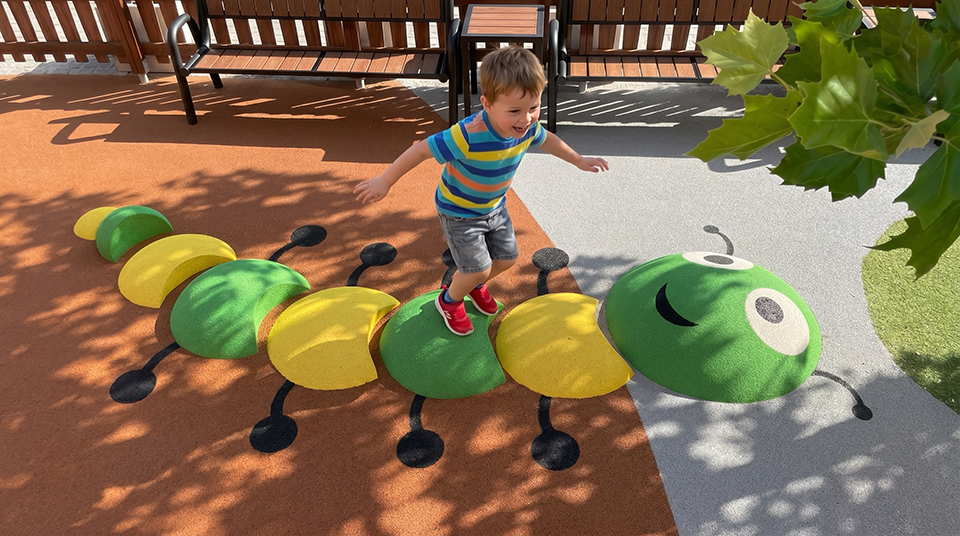
RubberBond Solutions’ poured-in-place surfacing systems are engineered for strong HIC performance, not just the minimum needed to pass a compliance test.
RubberBond Elevate carries an average HIC score of 450 — 55% safer than the ASTM threshold, and a meaningful safety margin that competing products can’t match!
Four things drive that number:
Premium EPDM Rubber Granules The top layer uses high-quality EPDM rubber that holds its elasticity and energy-absorbing properties through temperature swings and heavy use. Inferior granules harden in cold weather and degrade under UV exposure, causing HIC scores to climb over time. RubberBond’s EPDM is formulated to maintain performance characteristics through years of real-world conditions.
Engineered Base Layer The base isn’t an afterthought; it’s a functional part of the impact attenuation system. It works in combination with the top layer to maximize energy absorption at the depths required for each fall height rating. A weak or inconsistent base layer undermines the entire system. RubberBond’s doesn’t.
Seamless, Uniform Construction HIC testing is done at specific points on a surface. But children fall everywhere. Competing systems can have gaps in performance at seams, edges and joints where impact performance drops. RubberBond’s poured-in-place construction delivers uniform thickness and consistent material properties across the entire surface, so the tested performance is the real performance, everywhere.
Certified Installation The best-engineered product in the world underperforms if it’s installed wrong. RubberBond-certified installers are trained to maintain the precise thickness and sub-base conditions required to deliver rated HIC performance. Installation variability is one of the most common reasons surfaces fail in the field. RubberBond treats it like the engineering problem it is.
Where Competing Surfaces Fall Short
Not all surfacing systems are held to the same standard, and the gaps show up in the data.
- Loose-fill materials like wood fiber and rubber mulch are highly sensitive to displacement and compaction. HIC scores measured at installation can drift significantly as material settles, wears or migrates out of critical fall zones. Staying compliant requires constant depth monitoring and replenishment.
- Modular rubber tiles vary significantly in performance depending on manufacturing quality, installation precision and joint integrity. Tiles that shift or separate create localized low-performance zones that routine inspections often miss.
- Budget poured-in-place systems frequently use recycled crumb rubber of inconsistent quality. That inconsistency shows up as variable HIC scores and faster degradation under heavy use and UV exposure.
RubberBond’s combination of premium materials, engineered system design and certified installation is built specifically to avoid these failure modes.
G-Max and HIC: Understanding Both Numbers
HIC is frequently discussed alongside G-max, the other key metric in ASTM F1292 compliance testing. G-max measures peak deceleration, the single highest force spike during an impact. ASTM requires G-max to stay at or below 200.
The two numbers measure related but distinct things. G-max captures the worst single moment of an impact. HIC integrates the full deceleration profile over time, making it a more complete predictor of head injury risk. A surface can have an acceptable G-max while still performing poorly on HIC if it decelerates too rapidly.
Both numbers matter. RubberBond performs well on both.
The Safety Margin Every Playground Deserves
Choosing a playground surface is a decision that affects every child who will ever use that space. The right question isn’t just whether a surface passes a compliance test. It’s how much protection it delivers above that minimum threshold, and how long it holds that performance under real-world conditions.
RubberBond Solutions is built to deliver measurable safety: HIC scores well below 1,000, consistent across the full surface, maintained for the long term.
It’s not just about passing a test. It’s building a playground you can stand behind.
Ready to discuss the right surfacing system for your next project? Contact the RubberBond Solutions team today.